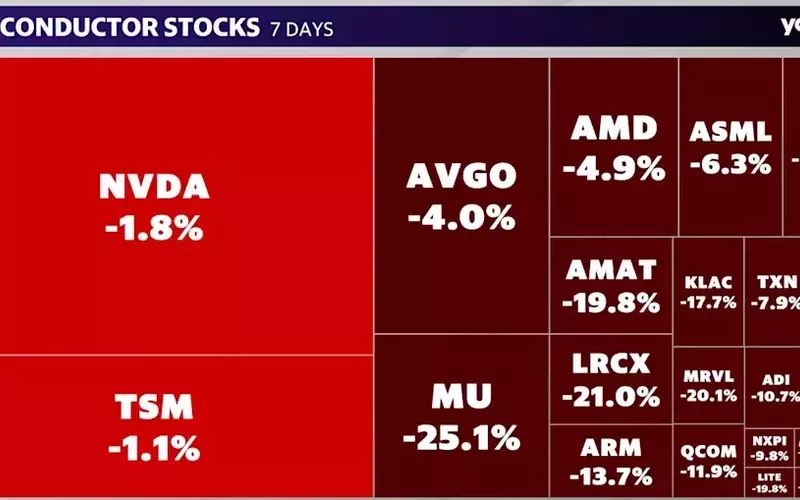

Samsung's recent preliminary second-quarter earnings, showcasing a dramatic surge in operating profit, unexpectedly triggered a downturn across the global semiconductor industry. This market reaction suggests that despite impressive financial performance, investors are increasingly questioning the long-term sustainability of the current growth trajectory in AI infrastructure spending. The widespread sell-off, impacting major chip manufacturers worldwide, indicates a recalibration of market expectations, moving beyond mere optimism to demand concrete evidence of sustained growth.
The semiconductor sector, previously buoyed by the AI boom, is now facing a critical evaluation. While the demand for chips remains strong, concerns are emerging about potential slowdowns in hyperscaler investments and the cyclical nature of memory prices. The introduction of new competitors, such as Chinese AI firms developing their own chips, further complicates the landscape, emphasizing that the AI market's expansion is not a linear, endless ascent. This shift reflects a market seeking tangible proof rather than just a positive outlook, suggesting a healthier, albeit more cautious, phase of growth.
Unexpected Market Reaction to Samsung's Strong Performance
Samsung Electronics recently announced preliminary second-quarter results that, on paper, appeared outstanding, revealing an almost 19-fold increase in operating profit compared to the previous year. However, this seemingly positive news paradoxically led to a significant sell-off in semiconductor stocks worldwide. Investors, who had already factored in substantial growth for the AI sector, reacted with skepticism, prompting declines in Samsung's own shares, as well as those of rivals like SK Hynix in South Korea, and major European and U.S. chip manufacturers such as ASML, STMicroelectronics, and Nvidia. This phenomenon illustrates a market where even exceptional performance struggles to meet the excessively optimistic expectations that had been built into stock valuations.
The market's lukewarm response to Samsung's stellar report underscores a critical shift in investor sentiment. While Samsung's operating profit, projected at 89.4 trillion won ($58.4 billion), and a more than doubling of revenue surpassed analyst estimates, the semiconductor industry, which has been a primary beneficiary of the AI infrastructure boom, has seen its stock prices rally significantly in anticipation of such strong results. This pre-emptive rally meant that the impressive figures, while historically robust, were already "priced in." Consequently, when the actual results were released, they failed to provide the additional positive surprise needed to propel share prices higher. Instead, the market interpreted the outcome as a sign that the sector's rapid growth might be reaching a plateau, leading to profit-taking and a reevaluation of future prospects. The market's reaction suggests that the era of simply asking whether AI is real has transitioned to questioning whether its valuation is justified, demanding more than just good news to sustain momentum.
Reassessing the AI Chip Market's Future and Valuations
The widespread decline in chip stocks following Samsung's strong earnings highlights a growing concern among investors regarding the sustainability of the current pace of AI infrastructure spending and the overall valuation of the semiconductor industry. The market is now questioning whether demand can continue to grow rapidly enough to justify the elevated prices of chip-related companies. This shift in perspective moves beyond mere enthusiasm for AI to a more critical examination of financial fundamentals and future growth drivers, especially as the sector has been heavily invested in with high expectations. The entry of new players, such as Chinese AI startups developing their own chips, further introduces complexities and potential shifts in market dynamics, suggesting a future where reliance on existing suppliers might diminish.
This reevaluation suggests that the market is undergoing a "valuation check," rather than a complete collapse. Investors are becoming more discerning, potentially rotating capital from highly valued technology stocks to other, less expensive market segments. The cyclical nature of the memory market, which has seen prices rise sharply, is also a point of concern, as historical patterns suggest that such upswings often precede downturns. If hyperscalers reduce their infrastructure budgets or if memory prices cool, it could significantly impact earnings. The emergence of independent chip development by Chinese AI firms, even for inference tasks, signals a potential long-term reduction in dependency on global suppliers, adding another layer of uncertainty to the future growth trajectory of AI demand. Overall, the market's message is clear: the AI trade now requires tangible proof of continued growth and sustainable profitability to justify current valuations, moving beyond speculative optimism towards a more grounded assessment of the sector's long-term health.