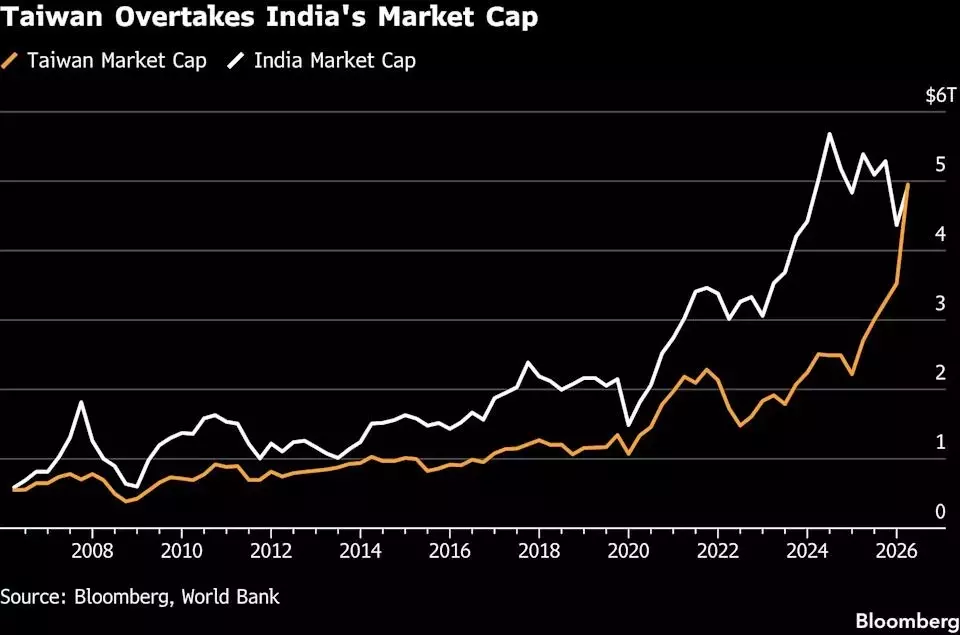
Taiwan's stock market has achieved a significant milestone, ascending to the fifth-largest globally, surpassing India. This remarkable growth is primarily attributed to the exceptional performance of Taiwan Semiconductor Manufacturing Co. (TSMC), a dominant force in the chipmaking industry. The island's market capitalization has soared to $4.95 trillion, demonstrating a robust investor confidence driven by the artificial intelligence boom. This development underscores a broader trend where technology-heavy markets, especially those with strong links to AI hardware manufacturing, are experiencing disproportional benefits in the current investment climate.
Taiwan's Market Ascendancy: A Deep Dive into Its Rise
On a significant Monday, the Taiwanese stock market officially reached a total capitalization of $4.95 trillion, according to Bloomberg's comprehensive data, thereby eclipsing India's $4.92 trillion market value. This impressive shift places Taiwan as the fifth-largest stock market worldwide, now trailing only the financial powerhouses of the United States, mainland China, Japan, and Hong Kong.
A major catalyst behind this surge is Taiwan Semiconductor Manufacturing Co. (TSMC), a global leader in chip manufacturing. TSMC's shares have experienced a staggering 46% rally this year, as the company skillfully capitalizes on the burgeoning artificial intelligence sector, where its advanced semiconductors play a pivotal role. This intense market concentration is evident, with TSMC now accounting for approximately 42% of the benchmark index. This phenomenon underscores the significant impact that leading technology firms have on national market performance in the current global economic landscape.
The growth of Taiwan's market capitalization is intrinsically linked to its substantial concentration in the technology hardware sector. This sector is currently at the epicenter of the AI investment cycle, drawing considerable global attention and capital. Yi Ping Liao, a fund manager at Franklin Templeton, articulated this point, highlighting that markets with limited exposure to technological hardware are increasingly being overshadowed by those heavily invested, such as Taiwan and South Korea. Conversely, India's market has been contending with escalating energy expenses, decelerated corporate earnings, and a relative lack of direct participation in the AI infrastructure development.
Adding to TSMC's favorable market conditions, new regulatory changes introduced last month by Taiwan's financial authorities have increased the investment limit for domestic funds in a single stock. Under the revised guidelines, funds exclusively investing in Taiwanese equities can now allocate up to 25% of their net assets to any listed company whose weighting exceeds 10% in the Taiwan Stock Exchange, a significant increase from the previous 10% cap. Currently, TSMC is the sole entity that meets this specific criterion, a move that JPMorgan Chase & Co. estimates could funnel over $6 billion in additional capital into the chip giant.
Despite Taiwan's ascendancy in market value, it is important to note that India's economy, valued at $4.15 trillion and recognized as one of the fastest-growing globally, substantially outweighs Taiwan's gross domestic product of $977 billion, as per estimates from the International Monetary Fund. This economic disparity highlights that while market capitalization is a key indicator of financial strength, it doesn't fully capture the broader economic scale of a nation.
Indian equities, in contrast, have experienced a downturn this year, marked by record foreign capital outflows. This is largely due to high valuations and a weakening rupee. Furthermore, elevated energy costs have intensified inflation worries and clouded the nation's economic growth forecasts. Global investors have divested nearly $24 billion from local equities this year, shifting their focus towards the more vibrant AI-driven markets of Taiwan and Korea. India's benchmark index has seen an 8% decline, signaling its first annual drop in a decade. Consequently, India's representation in the MSCI emerging markets index has decreased from 19% last year to approximately 12%.
Alison Shimada, a portfolio manager at Allspring Global Investments, remarked on the situation, observing that India has been largely overlooked for the past two years. She acknowledged India as an expensive market necessitating selective investment, yet pointed to the prominent financialization of savings within India, where individuals are increasingly shifting towards financial assets.
This narrative illustrates a dynamic shift in global financial markets, where technological innovation and strategic regulatory adjustments can rapidly redefine national economic standing, particularly within the highly competitive and interconnected world of technology and artificial intelligence.
The recent surge in Taiwan's stock market, primarily driven by TSMC's phenomenal growth, offers a compelling case study on the transformative power of technological leadership in the global economy. It highlights how a focused investment in advanced sectors, such as artificial intelligence and semiconductor manufacturing, can rapidly elevate a nation's financial standing. This also serves as a critical reminder for other economies, like India, to diversify and adapt their investment strategies to align with emerging global trends and technological advancements. The disparity in market performance between Taiwan and India underscores the necessity for nations to cultivate robust industries that are central to the future global economy, ensuring sustained growth and competitiveness on the international stage.