Unlock the Hidden Layers of Option Pricing: Master Extrinsic Value!
Defining Extrinsic Value in Financial Instruments
Extrinsic value represents the portion of an option's market price that surpasses its inherent or intrinsic worth. It essentially quantifies the additional value investors are willing to pay for an option based on potential future price movements, rather than its immediate profit potential. This concept stands in contrast to intrinsic value, which signifies the immediate profit one could realize if the option were exercised instantly.
Core Principles of Extrinsic Value
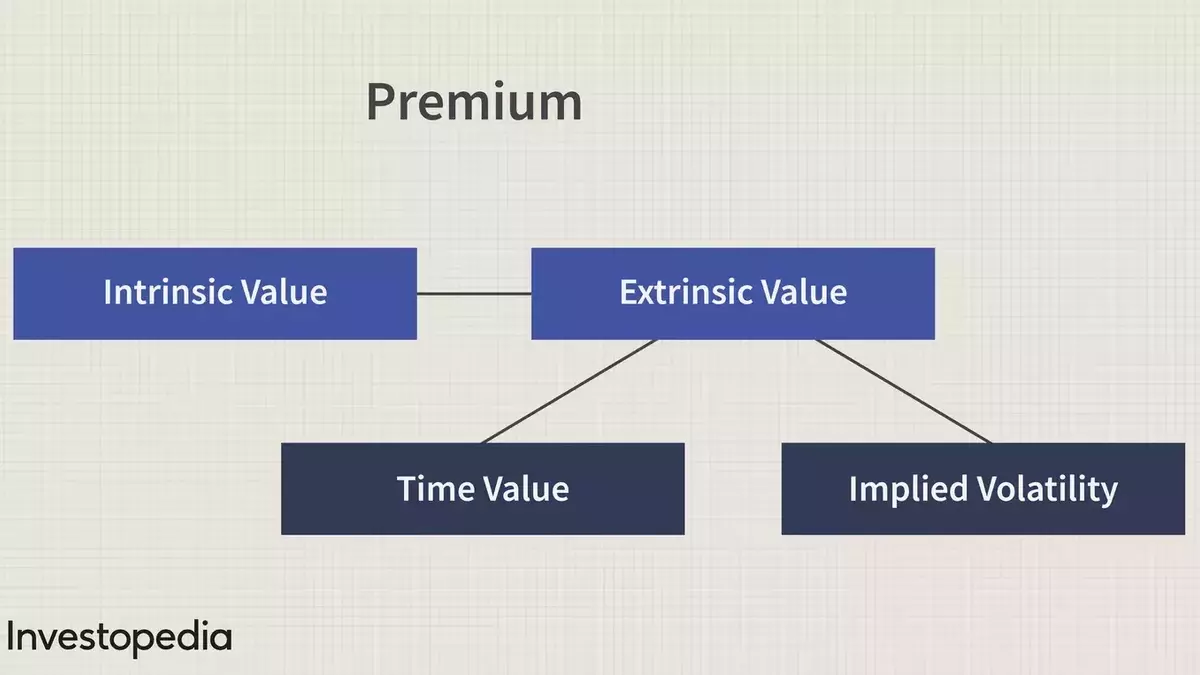
The total cost of an option, known as its premium, is composed of both intrinsic and extrinsic values. Intrinsic value is calculated as the difference between the underlying asset's current market price and the option's predetermined strike price, but only when the option is "in the money" (meaning it has immediate profit potential). For instance, if a call option has a strike price of $20 and the underlying stock trades at $22, it possesses an intrinsic value of $2. If the option's market price is $2.50, the remaining $0.50 constitutes its extrinsic value. Similarly, for options that are "out of the money" (having no immediate profit potential), their entire premium is derived solely from extrinsic value.
Key Determinants of Extrinsic Value
A primary driver of extrinsic value is the duration until an option's expiration, often referred to as its "time value." Options with longer periods until expiration typically command higher extrinsic values because there is more time for the underlying asset's price to move in a favorable direction. Consequently, as the expiration date draws nearer, the time value of an option diminishes. Another significant factor is implied volatility, which reflects the market's expectation of future price swings in the underlying asset. An increase in implied volatility generally leads to a rise in extrinsic value, as greater price fluctuations enhance the probability of the option becoming profitable.
Practical Illustration in Option Trading
Consider an investor purchasing a put option on XYZ stock when the stock is trading at $50, with a strike price of $45, and an expiration in five months. The option's premium is $3. At the time of purchase, this option has no intrinsic value because the stock price is above the strike price. If the stock's price and implied volatility remain constant, the option's premium will gradually decline towards zero as expiration approaches. However, if the stock price were to fall to $40, the option would gain $5 in intrinsic value. Should there still be time before expiration, the option's market price might be, for example, $5.50 or $6, with the excess above $5 representing its extrinsic value. It is important to note that intrinsic value does not equate to immediate profit. If the option expires with the stock at $40, its intrinsic value is $5, but the net profit for the trader would be $2 (the $5 intrinsic value minus the $3 premium paid).