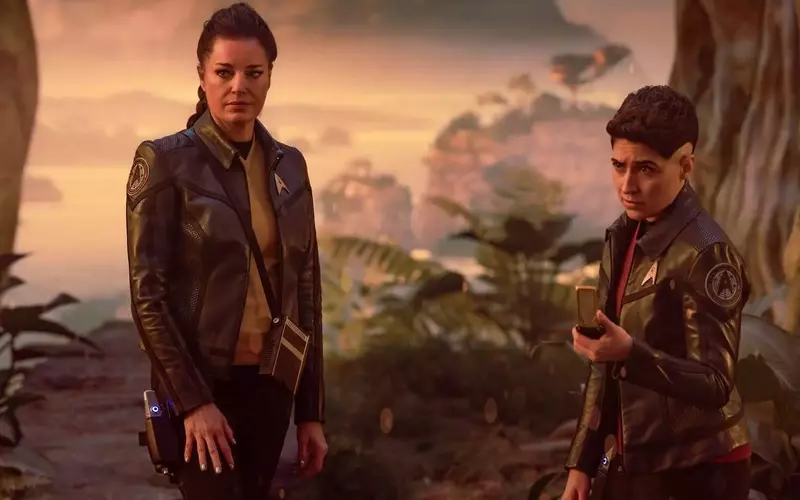

The fourth season of "Star Trek: Strange New Worlds" continues the series' established pattern of both remarkable success and noticeable shortcomings. Initially launched in 2022 as a spin-off, the show distinguished itself with an episodic narrative style and a focus on character evolution, diverging from the season-long arcs prevalent in other "Star Trek" productions on Paramount Plus. However, despite the creative efforts of showrunners Akiva Goldsman and Henry Alonso Myers, the series frequently prioritizes experimental episodes over consistent character progression, resulting in an uneven viewing experience. This season, as it builds towards Captain James T. Kirk's eventual command of the U.S.S. Enterprise, highlights this struggle, with rushed character developments overshadowed by ambitious yet sometimes bewildering plot devices. The show's tendency to embrace gimmicks, from noir-inspired episodes to holodeck mysteries and encounters with omnipotent beings, often leaves core characters feeling stagnant and underutilized.
This season also brings to light the show's persistent difficulty in fully developing its diverse ensemble. Characters like Una Chin-Riley and Nyota Uhura, despite their potential, are often relegated to storylines that either lack depth or divert focus away from their personal journeys. La'An Noonien-Singh's internal conflict regarding her lineage receives a clichéd resolution, while Erica Ortegas remains largely defined by her professional role. Yet, amidst these struggles, the series occasionally strikes gold, particularly when its inventive concepts align perfectly with character growth. Episodes like "Off-Hour" and "The Griffin Incident" skillfully use intense scenarios to foster emotional catharsis and explore profound fears. The season's standout "Level-Five Transporter Accident," though absurd, masterfully employs humor to reveal Spock's inner turmoil. As "Strange New Worlds" approaches its conclusion, it serves as a testament to both the franchise's enduring appeal and the challenges of balancing ambitious storytelling with cohesive character development, offering valuable lessons for future "Star Trek" endeavors.
Navigating Narrative Frontiers: The Blend of Innovation and Familiarity
"Star Trek: Strange New Worlds" has, since its inception, sought to recapture the episodic charm of earlier "Star Trek" iterations while simultaneously pushing creative boundaries. This season's journey sees the creative team attempting to balance this traditional storytelling with ambitious genre experiments. The black-and-white noir episode, "A Case of Chiaroscuro," exemplifies this approach, aiming for a nostalgic nod to classic "Next Generation" holodeck adventures but sometimes at the expense of coherent narrative logic and character development. The showrunners' desire to innovate with distinct episode formats often results in a collection of diverse stories, some of which resonate deeply, while others feel tangential to the overall character arcs and thematic progression of the series. This constant shifting between styles creates an engaging, albeit at times disjointed, viewing experience that keeps audiences on their toes, never quite knowing what to expect from one week to the next.
This innovative yet occasionally scattered approach to storytelling forms the core of "Strange New Worlds" Season 4. While the series often succeeds in delivering humorous, thrilling, and emotionally resonant moments that delve into classic "Star Trek" themes such as identity, duty, and ethics, its reliance on episodic gimmicks can sometimes undermine character consistency. The ambition to explore various genres, from stoner comedies to body horror, showcases the show's versatility but also leads to an inconsistent portrayal of its ensemble. Some characters thrive within these experimental frameworks, using the unique situations to reveal new facets of their personalities and emotional depth. However, others find themselves sidelined or confined to repetitive roles, struggling to achieve significant development amidst the ever-changing narrative landscapes. This tension between bold creative choices and the necessity of character-driven storytelling defines the fourth season, offering both peaks of brilliance and valleys of stagnation that mark the series' complex identity.
Character Journeys: Unfulfilled Potential and Unexpected Triumphs
The fourth season of "Star Trek: Strange New Worlds" vividly illustrates the dual nature of character development within its narrative framework. While certain core crew members receive limited attention, with their storylines either stagnating or being rushed, others find unexpected depth within the season's diverse episodes. For instance, Una Chin-Riley's character, despite being central to an ambitious noir episode, sees little significant evolution beyond previously established traits, suggesting a missed opportunity for profound exploration. Similarly, Nyota Uhura's arc is at times overshadowed by secondary characters, leading to a sense of unfulfilled potential. La'An Noonien-Singh's internal struggles with her heritage receive a resolution that some viewers might find overly simplistic, while Erica Ortegas's contributions largely remain confined to her professional duties, highlighting a recurring challenge for the showrunners in providing her with a distinct personal journey.
Despite these instances of underdevelopment, the season also features moments where characters truly shine, particularly when their personal arcs align seamlessly with the week's unique narrative. Episodes designed around high-stakes situations, such as "Off-Hour," skillfully employ relentless pacing to bring about earned emotional catharsis for characters like Chapel and M’Benga. "The Griffin Incident," with its surprising foray into body horror, effectively uses the classic trope of confronting fears to deepen characters, notably Sam Kirk and James Kirk, as they grapple with the demands of family and duty. The season's most audacious and arguably most successful experiment, "Level-Five Transporter Accident," transforms the crew into puppets, using this absurd premise to brilliantly expose Spock's inner turmoil, showcasing the series' capability to merge outlandish concepts with profound character insight. These triumphs demonstrate that when the show's genre-hopping aligns with genuine character exploration, "Strange New Worlds" truly excels, offering a compelling blend of entertainment and emotional depth that defines its best moments.