
Navigating New Frontiers: The SpaceX Market Phenomenon
Nasdaq's Unprecedented Move: Fast-Tracking SpaceX into the Nasdaq 100
The Nasdaq exchange has made a remarkable decision by including SpaceX, a major initial public offering (IPO), into its prestigious Nasdaq 100 index within merely fifteen trading days of its market debut. This rapid integration means SpaceX is now part of one of the market's most influential passive investment vehicles, even before a substantial portion of its shares are widely available for trading. This scenario creates an investment landscape rarely observed on such a grand scale, prompting considerable interest and analysis from market watchers.
The Power of Passive Investment: Index Funds and Mandatory Buying
Index funds operate under strict rules, requiring them to mirror the composition of their tracked benchmarks. With SpaceX's inclusion in the Nasdaq 100, funds aligned with this index are now mandated to purchase SpaceX shares. This influx of capital will necessitate a strategic adjustment of their existing portfolios to maintain alignment with the benchmark. This process, known as rebalancing, is projected to result in a significant wave of forced buying for SpaceX stock, with estimates ranging from billions of dollars according to financial institutions like JPMorgan and BNP Paribas.
The Supply Conundrum: Limited Float Meets High Demand
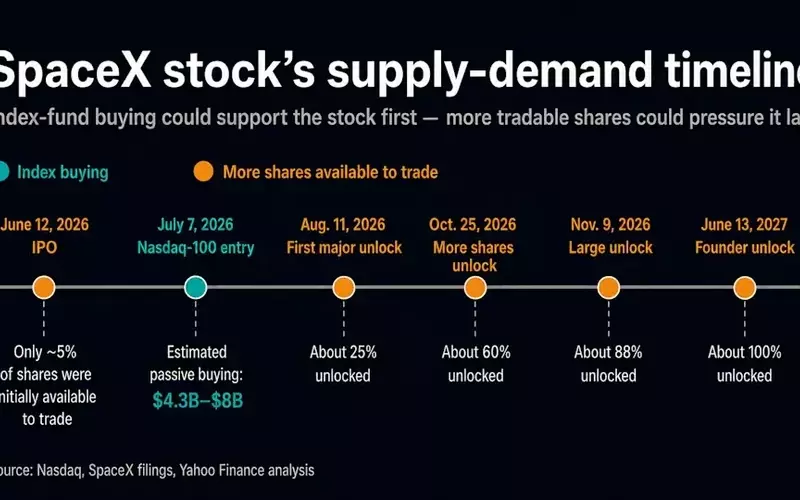
A critical factor in this market equation is the limited availability of SpaceX shares on the public market. Initially, only a small fraction of the company's total shares was accessible for public trading. The majority remains held by insiders, employees, and early investors, subject to lock-up periods that prevent immediate sale. This restricted 'float' contrasts sharply with the impending surge in demand from index funds, setting up a unique supply-demand dynamic. The accompanying chart visually illustrates this timing mismatch: index fund buying precedes the release of more tradable shares, with significant unlocks scheduled for later in the year.
Short-Term Momentum vs. Long-Term Valuation: A Dual Perspective
This staggered release of shares has immediate implications for SpaceX's stock price. The initial tight supply, coupled with mandatory purchases from index funds, is likely to provide strong support for the stock in the near term. However, this early price appreciation may not fully reflect the stock's intrinsic demand, as a true market test will only occur once a larger volume of shares becomes freely tradable. SpaceX's past performance, characterized by rapid gains followed by significant pullbacks, underscores the volatility that can arise from such market conditions.
Key Price Levels and Future Market Trajectories: Identifying Critical Thresholds
Investors are closely monitoring crucial price levels for SpaceX. The range of $172 to $180 is identified as a potential resistance zone, influenced by technical indicators and recent trading activity. A sustained breach above this level could pave the way for the stock to challenge its all-time high of over $200. Conversely, if the stock remains below this range, choppy trading is anticipated. A dip below $150 would signal a more bearish outlook, suggesting a shift in market sentiment and potentially sustained downward pressure.