Roki Sasaki's tenure as a starting pitcher for the Los Angeles Dodgers has been a subject of ongoing scrutiny and debate. Despite facing a higher earned run average this season compared to his debut year, Sasaki's performance under the hood reveals substantial progress. His improved command over velocity, streamlined pitching mechanics, and the introduction of new pitches, including a two-tiered splitter and a gyro-slider, underscore his potential. Nevertheless, an impending roster decision, amplified by the impending return of Blake Snell, casts uncertainty over Sasaki's immediate future in the major leagues, especially given his past struggles with self-assurance in lower-tier competition. This article delves into Sasaki's advancements and the strategic choices facing the Dodgers' coaching staff.
Roki Sasaki's On-Mound Evolution
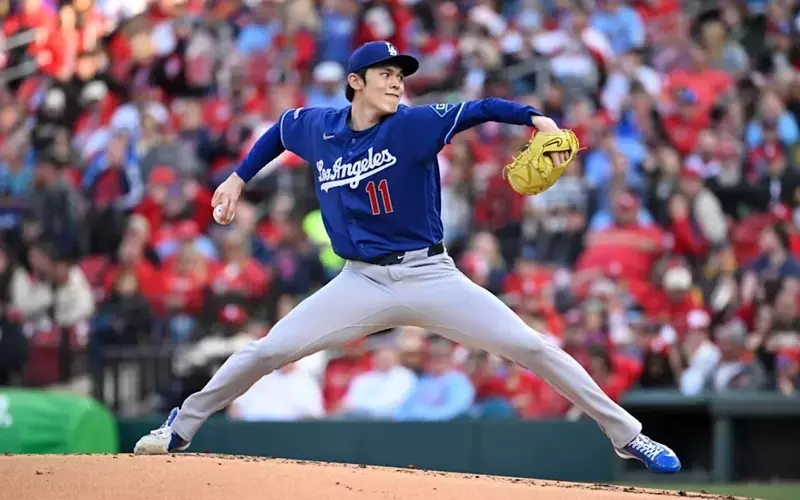
Roki Sasaki, the promising Los Angeles Dodgers pitcher, has been the subject of much debate regarding his role and performance. While his current season's earned run average of 5.97 over 28.2 innings in six starts appears less favorable than his rookie year's 4.46 ERA, a deeper dive into his mechanics and pitch repertoire reveals significant positive developments. Sasaki has demonstrably improved his fastball velocity consistency, now maintaining a steady 97 mph, a stark contrast to the erratic fluctuations observed in 2025. This newfound stability is a crucial step forward, despite his fastball's shape still leading to considerable contact when thrown in the strike zone, which has at times made him hesitant to rely on it for strikes. Furthermore, his overall pitching mechanics show greater fluidity and coordination, suggesting a more efficient and controlled delivery.
Beyond velocity and mechanics, Sasaki's pitch arsenal has expanded and refined. He now effectively deploys two distinct variations of his splitter: a typical splitter at around 90 mph that he can command for strikes, and a more devastating forkball that drops to approximately 84 mph with exceptional movement. This dual-splitter approach adds complexity to his offerings, making him a more unpredictable pitcher. Complementing these is his newly introduced 'gyro-slider,' a pitch with cutter-like characteristics that essentially serves as his fourth primary offering. This expansion is particularly significant as, in 2025, Sasaki primarily relied on a two-pitch repertoire, which raised concerns about his long-term viability as a starter. The 'gyro-slider' has proven effective in its limited use, and his refined splitter grip has enabled him to get ahead in counts more frequently. Although he has only made one start utilizing both splitter variations, against the St. Louis Cardinals, that outing was notably positive, hinting at the potential of his evolving arsenal. Despite the need for more time to fully master these new pitches, the progress is undeniable.
The Debate: Keeping Sasaki in the Major Leagues
The question of whether Roki Sasaki should remain in the major leagues or be demoted to Triple-A is multifaceted, with strong arguments supporting his continued presence with the Dodgers. A primary concern revolves around his confidence, which has historically been fragile when facing lower-level competition. During Spring Training, Sasaki visibly struggled with his self-belief, especially when pitching against minor league talent. This psychological aspect is crucial; a demotion, particularly now that he has begun to make significant adjustments and show signs of improvement, could severely undermine his confidence. His spring training statistics—an 8.62 ERA over 15.2 innings, with 15 earned runs and 18 walks—underscore this vulnerability to confidence issues when not challenged at the highest level. If he were to falter further against minor league hitters while attempting to hone his new skills, the negative impact on his mental game could be profound and long-lasting.
Moreover, the major leagues offer an unparalleled environment for development. There is no substitute for refining one's craft against the sport's elite hitters. By facing top-tier competition, Sasaki receives immediate and unforgiving feedback, which is essential for accelerating his learning curve and fully integrating his expanded pitch repertoire. The Dodgers, with their exceptional talent depth and the guidance of pitching expert Mark Prior, are uniquely positioned to support Sasaki's growth at the highest level. They can absorb some of the growing pains associated with his development without significantly jeopardizing their overall team performance. This strategic patience is further justified when considering the alternatives, such as Emmet Sheehan, whose mechanics have been more inconsistent than Sasaki's. Sheehan, for instance, might benefit more from a stint on the injured list or in the minor leagues to address his own issues. Therefore, allowing Sasaki to remain with the big league club, despite the roster crunch, is not only a vote of confidence but also a practical approach to foster his long-term success and capitalize on the progress he has already made.