
The film "Transformers: Rise of the Beasts" has recently become accessible for free streaming, presenting a fresh opportunity to delve into its interpretation of the beloved "Beast Wars" universe. This movie holds particular significance for those who grew up with the 1990s animated series, often considered superior to its 1980s counterpart due to its intricate narratives and profound character development. While the cinematic adaptation has faced criticism for certain compromises, its arrival on streaming platforms provides a compelling reason for both new viewers and long-time fans to engage with this unique chapter in the Transformers saga.
"Transformers: Rise of the Beasts," directed by Steven Caple Jr., primarily unfolds in 1994, positioning it as a continuation of "Bumblebee" (set in 1987) and a precursor to Michael Bay's 2007 "Transformers" film. Despite ongoing fan discussions regarding its precise place in the timeline, the movie largely functions as a self-contained story. The narrative commences with a dramatic struggle on the Maximal homeworld, where the planet-devouring Unicron, heralded by the menacing Terrorcon Scourge, threatens existence. The Maximals, led by Optimus Primal, embark on a perilous mission to protect the Transwarp Key, a powerful artifact capable of manipulating time and space. This quest eventually brings them to prehistoric Earth, where the key is hidden until its rediscovery in 1994, triggering a monumental conflict that forces the Maximals and Autobots to unite against Unicron's destructive advance.
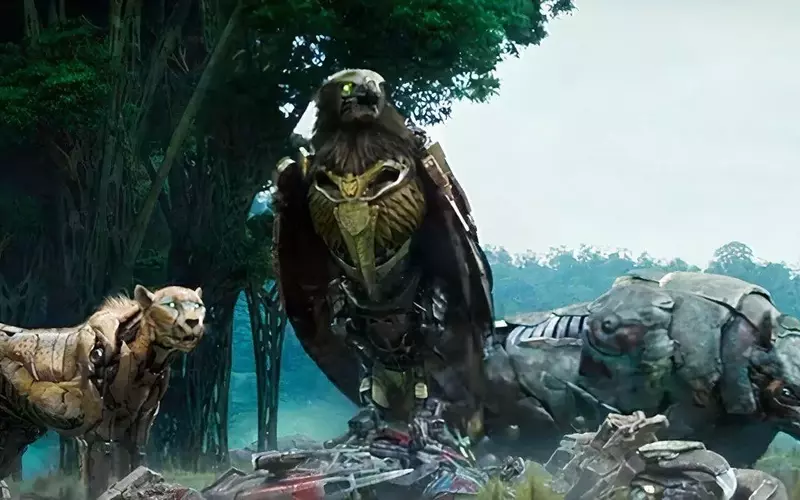
However, "Transformers: Rise of the Beasts" is not without its imperfections, sharing some narrative complexities and character superficiality with earlier Transformers films. Key characters like Rhinox, a pivotal figure in the "Beast Wars" series, receive limited dialogue and development, reducing their impact within the story. Additionally, the film prioritizes the Autobots, relegating the Maximals to a secondary role, and omits several iconic "Beast Wars" characters. Despite these drawbacks, the movie's visual fidelity to the Maximals is a major highlight. The design team successfully reimagined characters like Airazor, Rhinox, Cheetor, and Optimus Primal, scaling them to effectively interact with the Autobots while maintaining strong ties to their original animated appearances. Airazor, for instance, exhibits remarkable faithfulness to her 1990s cartoon design in both beast and robot forms. Rhinox is depicted as a formidable force, and Cheetor's sleek design draws inspiration from "Beast Machines." Optimus Primal's hulking beast mode echoes "Beast Machines," while his robot mode remains true to "Beast Wars," albeit with a more subdued color palette.
Ultimately, the meticulous and striking portrayal of the Maximals alone offers sufficient motivation to watch "Transformers: Rise of the Beasts." While it may not reach the pinnacle of cinematic achievement within the Transformers franchise, it serves as a crucial cinematic representation for "Beast Wars" enthusiasts. The dedication to faithfully adapting these beloved characters ensures a satisfying experience for fans who have long awaited their big-screen debut. Even as the desire for a standalone "Beast Wars" movie persists, "Rise of the Beasts" acts as a compelling placeholder until that vision potentially materializes.