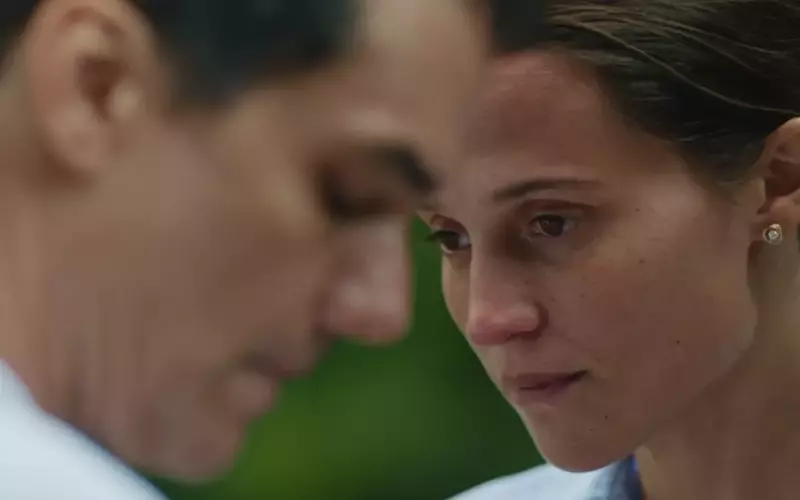

Rachel Rose's debut feature, "The Last Day," meticulously examines the intricate inner worlds of two women navigating the complexities of modern motherhood against the backdrop of an American holiday. The film, starring Alicia Vikander and Victoria Pedretti, masterfully portrays the often-unseen emotional burdens and silent crises experienced by mothers. Through its elegant restraint and perceptive character studies, it echoes the philosophical depth of Virginia Woolf's "Mrs. Dalloway," offering a contemporary lens on themes of domesticity, personal identity, and the elusive nature of contentment. Rose's artistic background shines through in the film's visual and auditory precision, creating an atmosphere that is both serene and unsettling, drawing viewers into the characters' profound sense of dislocation from their own lives. The film challenges conventional narratives of female experience, presenting a nuanced exploration of the internal landscapes that define and sometimes constrain women's roles.
The narrative subtly explores how outward appearances of normalcy can mask deep-seated dissatisfaction and emotional struggles. Both protagonists, despite their differing circumstances, share a common thread of feeling disconnected from their true selves, striving to maintain a facade of order while grappling with internal turmoil. The film's deliberate pacing and absence of dramatic resolution serve to emphasize the ongoing, often unacknowledged, nature of these personal challenges, leaving a lasting impression that resonates beyond the screen. It is a work that invites introspection, compelling audiences to consider the hidden emotional currents beneath the surface of everyday life and the quiet resilience required to navigate them.
The Weight of Unspoken Discontent: A Contemporary 'Mrs. Dalloway'
Rachel Rose's cinematic debut, "The Last Day," skillfully reinterprets Virginia Woolf's "Mrs. Dalloway" for a modern audience, focusing on the internal lives of two mothers, portrayed with nuanced depth by Alicia Vikander and Victoria Pedretti. Set on the Fourth of July, the film uses the festive facade of the holiday to highlight the underlying emotional isolation and quiet despair experienced by its protagonists. It is a subtle exploration of how societal expectations and personal aspirations can diverge, leaving individuals feeling adrift in their own existence. The movie eschews overt drama in favor of a profound psychological realism, meticulously crafting an atmosphere where unspoken feelings and internal conflicts take precedence over external events. This approach allows for a rich and empathetic portrayal of the challenges inherent in balancing personal identity with the demands of family life, particularly for women.
The film's strength lies in its ability to articulate the intangible sense of being out of sync with one's life, a feeling that permeates the experiences of both Julia (Vikander) and Taylor (Pedretti). Julia, a former author, grapples with the loss of her creative self amidst the routines of marriage and motherhood, her poised exterior barely concealing an inner struggle for purpose. Taylor, on the other hand, silently battles postpartum depression, her exhaustion and disorientation palpable despite the lack of explicit exposition. Their individual journeys, though seemingly mundane, are punctuated by moments of intense internal conflict and a yearning for something more. Rose's direction, combined with exquisite cinematography and sound design, creates a sensory experience that mirrors the characters' emotional states, where beauty and tension coexist. The film is a poignant commentary on the silent battles fought within the domestic sphere, offering a mirror to those who may recognize these deeply personal, often isolating, experiences.
Navigating the Inner Landscape: The Art of Subtle Storytelling
"The Last Day" distinguishes itself through its understated yet powerful narrative, a testament to Rachel Rose's mastery of subtle storytelling. The film meticulously crafts an environment where the internal world of its characters, rather than external plot points, drives the narrative forward. Both Julia and Taylor, despite leading outwardly uneventful days, are constantly processing complex emotions and silent crises. Julia's meticulously planned Fourth of July party, meant to project an image of control and happiness, becomes a canvas for her simmering dissatisfaction and unresolved past. Her encounter with an ex-lover briefly ignites a suppressed anger, revealing the fragility of her composure. Taylor's struggles with postpartum depression are depicted through her raw, distant demeanor, underscored by the unsettling presence of fire-station test sirens that serve as an eerie premonition of her internal breaking point. These subtle hints and sensory details create a rich tapestry of emotional depth, allowing the audience to intuit the characters' inner turmoil without explicit dialogue.
The film's deliberate lack of a grand climax or a clear resolution for the characters' intersecting arcs is a deliberate choice that underscores its central theme: the ongoing nature of internal struggle. The lives of Julia and Taylor, like many, don't conclude with a dramatic catharsis but rather continue with an unsettling, unidentified tension. This approach might challenge viewers accustomed to conventional narrative structures, yet it profoundly speaks to the reality of lives lived in passive crisis. Rose's work invites a deeper engagement, prompting reflection on the pervasive feelings of detachment and unfulfillment that can exist beneath a seemingly normal surface. It suggests that true understanding often lies not in definitive answers, but in the recognition and empathy for the unnamed feelings that shape human experience, leaving a lasting, resonant impact on the audience.