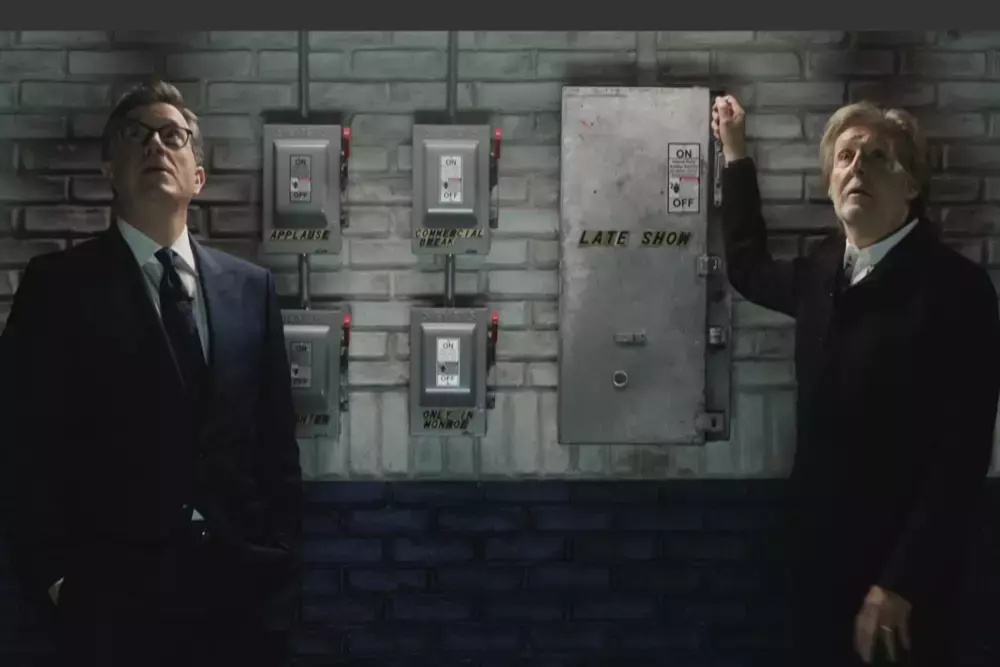
In a memorable and poignant conclusion to "The Late Show With Stephen Colbert," legendary musician Paul McCartney delivered a surprise appearance, providing a captivating performance and a symbolic closing gesture. The former Beatle joined Colbert for a heartwarming rendition of "Hello Goodbye" and was given the honor of switching off the lights at the historic Ed Sullivan Theater, a venue deeply intertwined with his illustrious career. The star-studded finale also featured other musical guests and a cavalcade of celebrities, creating a night filled with nostalgia, humor, and a touching farewell to a significant era in late-night television.
The evening's climax saw McCartney and Colbert performing a spirited duet of The Beatles' classic "Hello Goodbye." They were accompanied by Elvis Costello, former bandleader Jon Batiste, and current bandleader Louis Cato. The stage soon became a lively scene as a procession of staff members danced through the set, and the house band infused the 1960s tune with a New Orleans-style flair. Following the musical segment, a pre-filmed sequence showed McCartney and Colbert heading backstage to the electrical breakers. There, the rock icon flipped a switch, not only dimming the lights but also, in a playful narrative twist, sending the Sullivan Theater into a green interdimensional portal, an element introduced earlier in the broadcast by astrophysicist Neil deGrasse Tyson.
Before the grand finale, McCartney engaged in an insightful interview, reflecting on his first visit to the Ed Sullivan Theater 62 years prior. He recounted The Beatles' initial trepidation mixed with youthful confidence before their groundbreaking performance on "The Ed Sullivan Show" on February 9, 1964. This event is widely recognized as a pivotal moment that catapulted the band to unparalleled global stardom, drawing an estimated 73 million viewers—roughly half of the U.S. population at the time. McCartney shared a humorous anecdote about applying bright orange stage makeup backstage, prompting a lighthearted quip from Colbert about its unexpected modern-day popularity, though the host largely steered clear of overt political commentary throughout the episode.
The final broadcast of "The Late Show" largely maintained a non-political tone, a departure from some of Colbert's previous episodes. The opening monologue, for instance, focused on whimsical topics like airport runway potholes, signaling a desire to conclude on a less confrontational note. Numerous celebrities, including Bryan Cranston, Paul Rudd, Ryan Reynolds, Tim Meadows, and Tig Notaro, made cameo appearances, playfully expressing their surprise at not being the ultimate guest. The narrative of the green wormhole continued, with deGrasse Tyson explaining its physics before being seemingly drawn in. This was followed by appearances from fellow late-night hosts Jimmy Kimmel, Jimmy Fallon, Seth Meyers, and John Oliver, who implied that the 'wormhole' represented the end of an era for them as well, with Colbert leading the way.
Paul McCartney's connection with the Ed Sullivan Theater extends beyond his 1964 appearance. He revisited the venue on July 15, 2009, performing on the marquee for an episode of David Letterman’s show. After Colbert took over from Letterman, McCartney also appeared for an interview in 2019 to promote his children's book. His interactions with Colbert predate "The Late Show," including an hour-long interview and performance for Colbert's Comedy Central series in 2013. The "Late Show" finale ran longer than its usual one-hour slot, extending until 12:54 p.m. ET, surpassing David Letterman's farewell show in 2015. The future of the Ed Sullivan Theater, a designated historical landmark, remains uncertain, with CBS having made no announcements regarding its continued use after the show's conclusion, though its landmark status mandates its continued operation as a theater.