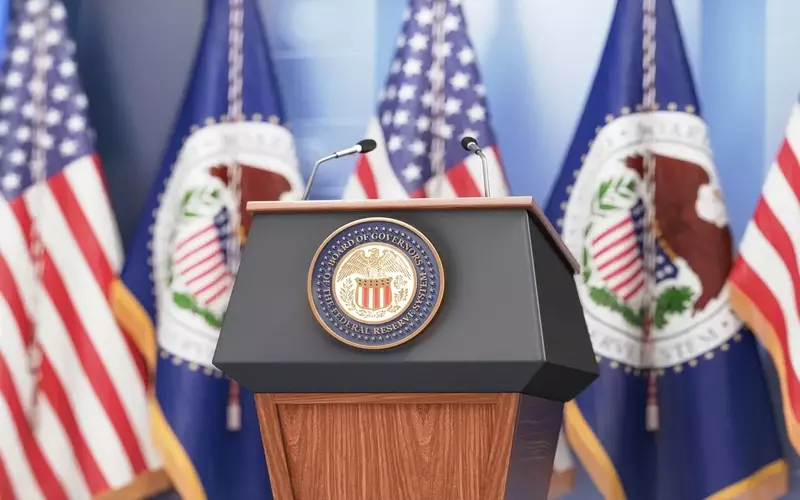

The Federal Reserve's recent decision to keep interest rates unchanged, coupled with a notable change in communication strategy under Chairman Warsh, has introduced a new layer of uncertainty into financial markets. This shift away from explicit forward guidance means investors will need to adapt to a less predictable policy environment. Despite some hawkish sentiment among policymakers and a subsequent uptick in Treasury yields, the likelihood of further rate hikes appears minimal. Instead, the economic landscape suggests a different trajectory, with inflation expected to stabilize and improvements in global supply chains contributing to overall market stability. Looking ahead, the next significant policy adjustment from the Fed is anticipated to be a rate cut, potentially as far out as 2027, driven by resilient consumer spending and a surge in AI-related capital investments, which are collectively fostering moderate economic growth.
The central bank's move to hold rates steady, while seemingly uneventful, marks a pivotal moment in its operational approach. The previous reliance on clear forward guidance aimed to steer market expectations and reduce volatility. However, the current administration seems poised to adopt a more flexible stance, allowing for greater discretion in response to evolving economic data. This change, though intended to provide more agility, inherently leads to short-term market adjustments as participants recalibrate their strategies in the absence of explicit future commitments. The initial reaction, characterized by rising Treasury yields, reflects this recalibration, as market players seek to price in the implications of a less transparent policy outlook. This dynamic underscores the critical importance of closely monitoring economic indicators and Fed rhetoric for subtle clues about future policy direction, a task that becomes more nuanced without the benefit of direct forward guidance.
Federal Reserve's Evolving Stance and Market Reaction
The Federal Reserve’s recent decision to maintain its current interest rate levels, while not a surprise in itself, has nonetheless initiated significant market recalibrations. This stability in rates comes amidst a broader strategic shift within the central bank, particularly under the leadership of Chairman Warsh, who appears to be moving away from the more explicit forward guidance that characterized previous regimes. This change in communication style has introduced a degree of uncertainty, requiring investors to adjust their expectations and strategies in an environment where future policy moves are less overtly telegraphed. The immediate consequence has been an increase in market volatility as participants grapple with interpreting the Fed's long-term intentions without direct pre-commitments, signaling a period of adaptation for market participants to the nuances of a more discretionary monetary policy.
The departure from a clear easing bias and the projection of more aggressive rate hikes by certain officials have notably influenced Treasury yields, pushing them upwards. However, analysis suggests that the peak for 2-year Treasury yields is likely around 4.2%, indicating that current hawkish sentiments may not translate into sustained aggressive tightening. Despite these signals, there remains a strong conviction that actual rate hikes are highly improbable. This outlook is predicated on the anticipation of inflation peaking and significant improvements in global supply chains, exemplified by the reopening of critical trade routes like the Strait of Hormuz. These factors collectively suggest that the economic conditions underpinning the need for further rate increases are diminishing, paving the way for a potential shift towards rate cuts in the longer term. The market's challenge now lies in discerning short-term reactions from long-term trends, especially in the context of an evolving Fed communication strategy.
Economic Resilience and Future Policy Directions
Despite the cautious stance adopted by the Federal Reserve and the ongoing adjustments in market expectations, the underlying economic fundamentals demonstrate notable resilience. Consumer spending continues to be a driving force, showing robust real retail sales growth. This sustained demand, coupled with significant capital investments driven by advancements in artificial intelligence, is collectively contributing to a steady, albeit sub-2%, economic expansion. Such indicators suggest a healthy economic backdrop that, while not overheating, is sufficiently stable to support current policy settings. This stability in consumer behavior and business investment is a critical component in shaping the Federal Reserve's long-term strategy, potentially allowing for a more measured approach to future policy adjustments, even as market dynamics respond to subtle shifts in central bank communication.
Looking ahead, the combination of peaking inflation and improvements in global supply chains is expected to alleviate pressure on the Federal Reserve to implement further restrictive monetary policies. The anticipated normalization of these economic factors provides the central bank with greater flexibility. Consequently, the next significant policy action from the Fed is projected to be a rate cut, which is not expected until 2027. This long-term outlook underscores a belief that current economic conditions, including resilient consumer activity and strategic capital deployment in areas like AI, will pave the way for a future environment conducive to easing monetary policy. This patient approach signifies the Fed's confidence in the economy's ability to self-correct and grow sustainably without immediate interventions, emphasizing a forward-looking strategy that anticipates and plans for future economic shifts.