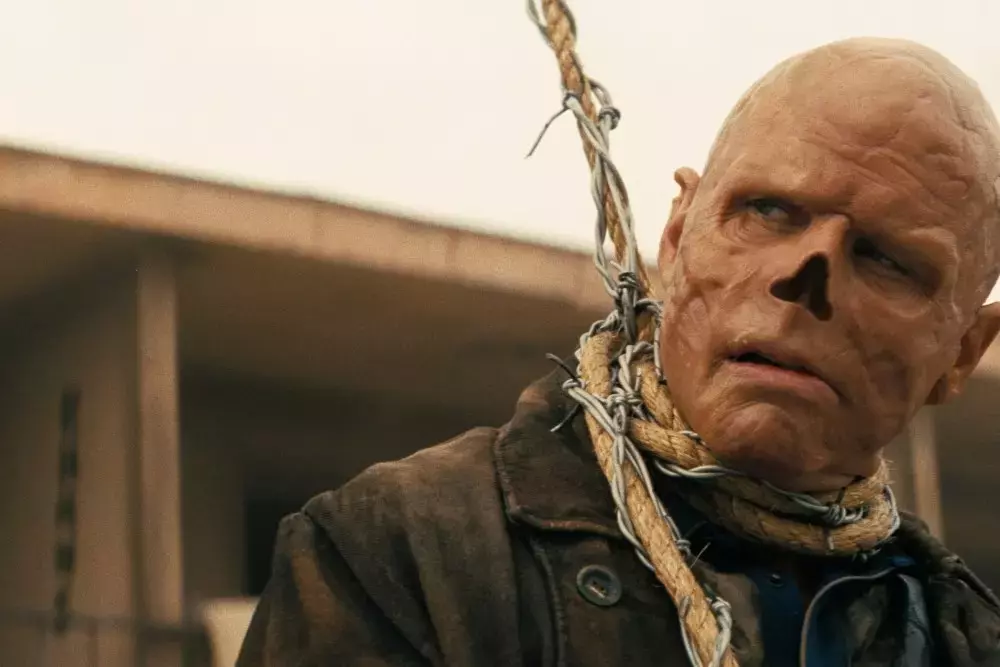
In the dynamic realm of television production, makeup artists are pushing the boundaries of character transformation, utilizing a spectrum of techniques from nuanced adjustments to extensive prosthetic applications. Across acclaimed series such as "Fallout," "Chad Powers," and "Stranger Things," the shared objective remains consistent: to craft compelling visual metamorphoses that amplify, rather than overshadow, the actors' performances.
For Prime Video's post-apocalyptic saga "Fallout," the character of the Ghoul, portrayed by Walton Goggins, undergoes a dramatic physical alteration. Jake Gerber, the head of the prosthetic department, meticulously designed nine silicon pieces to achieve the Ghoul's distinctive appearance. Initially, this elaborate application process consumed five hours, a duration Gerber successfully streamlined to under two and a half hours for the subsequent season. While the Ghoul's transformation involved significant facial coverage, ensuring precision for other characters, like Johnny Pemberton's Thaddeus, presented its own unique set of challenges. Thaddeus's subtle change, requiring only three pieces (a forehead with a receding hairline and two facial sections), demanded an even greater degree of accuracy. Gerber highlighted that even a minuscule misalignment could compromise the entire aesthetic, in stark contrast to the more forgiving nature of the Ghoul's extensive prosthetics.
Adding another layer of complexity to "Fallout" was the introduction of Ghoul children. While their makeup was less intricate, the primary hurdle lay in adhering to strict labor laws governing child actors, which limit their work hours to eight per day. This necessitated an expedited makeup application process, with the team aiming to complete each child's transformation within 45 minutes, often achieving it in just half an hour. To meet these stringent deadlines, Gerber implemented a strategy of doubling the number of makeup artists, thereby enhancing efficiency and speed.
In contrast to the extensive transformations seen in "Fallout" and "Stranger Things," Hulu's "Chad Powers" showcased a more subtle, yet equally demanding, form of disguise makeup. Special makeup effects designer Vincent Van Dyke and makeup department head Alexei Dmitriew collaborated to transform Glen Powell into Chad Powers, an eccentric football talent. The core challenge for Van Dyke was to create a convincing disguise that allowed Powell's underlying performance to shine through. The creative team deliberately avoided the cliché of a mask being abruptly removed, instead opting to depict a realistic and detailed application process, mirroring actual professional makeup techniques. This involved creating multiple plaster head casts of Powell, allowing Van Dyke to experiment with various elements in a "Mr. Potato Head" fashion. The final transformation, completed in under an hour, included a custom lace wig, dentures, a forehead piece, a nose and cheek piece, and upper lip appliances, meticulously enhanced with airbrushing and freckles to achieve a lifelike skin tone.
Meanwhile, Netflix's "Stranger Things" demanded a monumental overhaul for the character of Vecna, portrayed by Jamie Campbell Bower. Following Vecna's fiery encounter at the end of Season 4, showrunners Matt and Ross Duffer envisioned a more formidable and menacing "Vecna 2.0." Makeup effects department head Barrie Gower interpreted this vision as "Vecna on steroids," aiming to convey the amplified essence and power of the Upside Down flowing through him. This involved incorporating more negative space into his design and enabling his arms to function as weapons, necessitating close collaboration with the VFX team. Gower focused on creating head and shoulder prosthetics, while preserving Vecna's right arm to allow for greater dexterity in Campbell Bower's performance. The re-imagined Vecna also featured extended fingers, a custom Lycra catsuit with digitally printed patterns for texture reference, and advancements in 3D printing technology. Gower leveraged 3D printing to create highly detailed spikes and horns, seamlessly integrating them into the traditional sculpting process. This blend of classic and cutting-edge techniques resulted in a more intricate and intensified look for Vecna, comprising 11 to 12 overlapping pieces, new contact lenses, and dentures, elevating the character's visual impact to an unprecedented level.
The narratives highlight the meticulous artistry and technical innovation employed by makeup and VFX professionals in contemporary television. Their work, ranging from intricate character prosthetics to subtle disguise makeovers, underscores a commitment to enhancing storytelling while preserving the authenticity of actor portrayals, even under the most demanding production conditions. These craftspeople continually adapt and evolve, integrating new technologies like 3D printing with established techniques to achieve increasingly complex and realistic visual effects, thereby enriching the immersive experience for audiences.