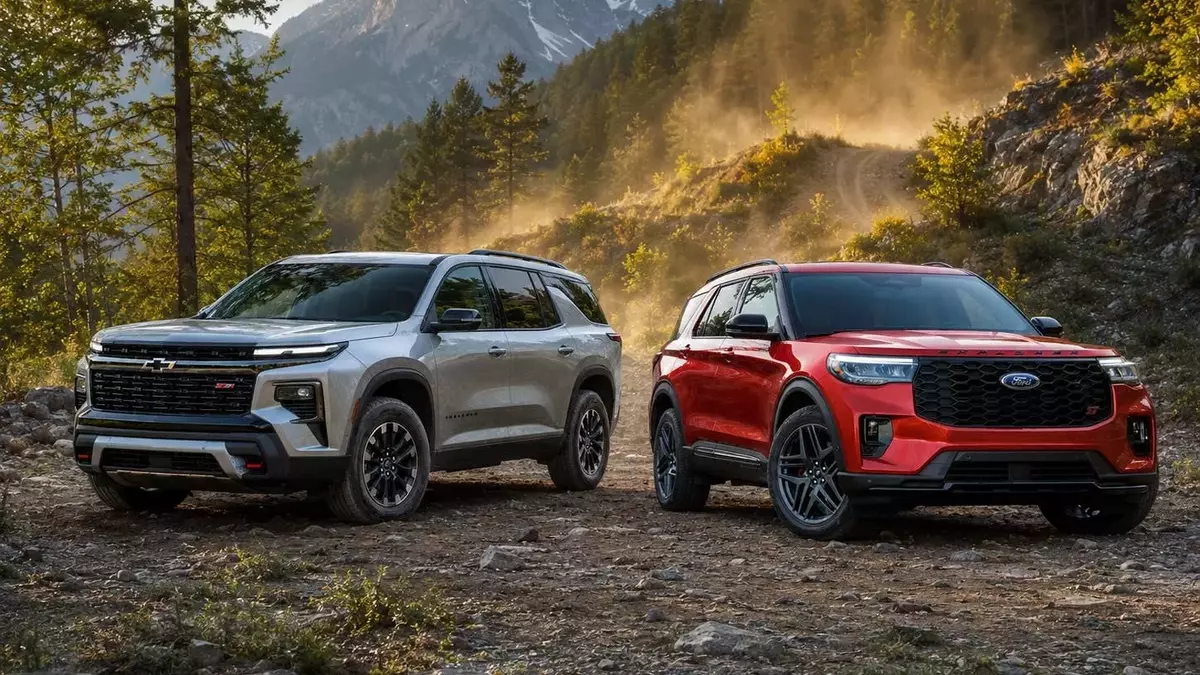
In the evolving landscape of family SUVs, the 2026 Ford Explorer Tremor and 2026 Chevrolet Traverse Z71 represent a new breed that combines practicality with genuine off-road prowess. This detailed analysis pits these two formidable vehicles against each other, examining their core mechanical differences, on-road comfort, and trail-conquering abilities. From engine performance to specialized suspension systems and ground clearance, every aspect is scrutinized to reveal which SUV truly excels when the pavement ends. This comparison serves as an essential guide for families seeking a versatile vehicle capable of navigating both urban jungles and challenging natural environments.
The Ultimate Off-Road Family SUV Face-Off: Ford Explorer Tremor vs. Chevrolet Traverse Z71
In a highly anticipated showdown in the automotive world, the 2026 Ford Explorer Tremor and the 2026 Chevrolet Traverse Z71 recently entered a direct head-to-head competition to establish which vehicle truly offers superior off-road capabilities. This contest was not merely about aesthetic ruggedness, but a rigorous evaluation of their fundamental engineering and specialized features designed for challenging terrains. Both models, aimed at the family SUV market, come equipped with significant enhancements that distinguish them from their standard counterparts, signaling a departure from the era when 'off-road' badges were largely symbolic. The Explorer Tremor, boasting an impressive 8.7 inches of ground clearance, stands a measurable height above the Traverse Z71's 7.8 inches. This crucial difference, nearly a full inch, significantly impacts their ability to clear obstacles on technical trails.
Beneath the hood, the Explorer Tremor provides a choice of two potent engines. The standard 2.3-liter EcoBoost four-cylinder engine delivers a robust 300 horsepower, while an optional 3.0-liter EcoBoost V6 engine elevates performance to an exhilarating 400 horsepower and 415 lb-ft of torque. Both powerplants are mated to a smooth 10-speed automatic transmission, with all-wheel drive being a standard feature across all Tremor models. In contrast, the Traverse Z71 is powered by a turbocharged 2.5-liter four-cylinder engine, producing 328 horsepower and 326 lb-ft of torque, coupled with an eight-speed automatic transmission. All-wheel drive is also standard on the Z71 trim, setting it apart from other Traverse variants. While the Traverse's engine is respectable, experts note that the Explorer Tremor's optional V6 offers a distinct power advantage, especially at lower speeds where its 415 lb-ft of torque provides a critical edge for managing throttle input on loose surfaces. Reviewers have highlighted that the Traverse's engine can feel underpowered for its size, particularly during rapid acceleration, which can be a limiting factor in scenarios demanding precise, controlled power delivery off-road.
When it comes to specialized off-road equipment, the differences between the two vehicles become even more pronounced. The Explorer Tremor is engineered with a 24.1-degree approach angle, a 23.7-degree departure angle, and an 18.7-degree breakover angle. It rolls on substantial 31-inch Bridgestone Dueler all-terrain tires and features a lifted suspension. Ford has also incorporated steel deflector plates for vital undercarriage protection, a Torsen limited-slip rear axle for superior traction, and an off-road-tuned suspension system. Its Terrain Management System offers six distinct drive modes, including an exclusive Trail mode. The Traverse Z71, on the other hand, comes with 18-inch all-terrain tires, rugged bumper designs, front recovery hooks, an advanced twin-clutch all-wheel-drive system, and a front skid plate, alongside an off-road-tuned suspension. While it also offers improved approach and departure angles over standard Traverse models, these figures are not officially published to the same detail as the Tremor. The Z71's Terrain Mode adjusts engine and brake responses for varying terrains, and it includes Hill Descent Control. The hardware disparity is significant, with the Tremor's additional ground clearance and mechanical Torsen differential providing a more robust solution for extremely challenging conditions where electronic systems might falter.
Performance on and off the road also distinguishes these two contenders. The Explorer Tremor strikes an admirable balance, offering competent off-road capability without sacrificing on-road comfort. Its all-terrain tires produce minimal road noise at highway speeds, and its suspension effectively absorbs uneven terrain, ensuring a pleasant ride for passengers during daily commutes. Initial evaluations confirm its strong performance on slippery and loose surfaces, where its all-terrain tires and AWD system instill genuine confidence. The Traverse Z71 presents a different experience. While it proves to be a capable light off-roader, handling gravel, mud, and uneven paths with confidence, its ride quality has been noted as a significant weakness. Testers observed that the Z71's off-road suspension introduces a level of stiffness that compromises the smooth ride expected from its base model, without achieving the same level of extreme trail capability as the Tremor. Essentially, the Traverse Z71 is designed for less demanding unpaved roads leading to campsites, rather than aggressive off-road trails that require careful terrain assessment.
Ultimately, the 2026 Ford Explorer Tremor emerges as the more capable off-road vehicle. Its superior ground clearance, more aggressive approach and departure angles, larger all-terrain tires, and the option of a more powerful V6 engine give it a definitive edge. The Torsen limited-slip rear axle and a more comprehensive drive mode system further solidify its standing for serious off-road excursions. While the Traverse Z71 is a well-equipped and approachable vehicle for moderate adventurous use, the Explorer Tremor offers a deeper level of capability for those whose primary focus is conquering challenging trails. With a starting price of approximately $50,160 for the Tremor versus $48,900 for the Z71, the marginal price difference is well justified by the significant gap in off-road prowess, making the Tremor the preferred choice for dedicated trail enthusiasts.
This comparison between the Ford Explorer Tremor and Chevrolet Traverse Z71 highlights a growing trend in the automotive industry: the integration of genuine off-road capability into family-friendly SUVs. As consumers seek vehicles that can seamlessly transition from daily commutes to adventurous weekends, manufacturers are responding with models that offer more than just rugged aesthetics. For me, the most significant takeaway from this analysis is the importance of understanding the true definition of "off-road readiness" for individual needs. While both vehicles certainly impress, the article underscores that even within the specialized segment of off-road SUVs, there's a spectrum of capability. The Explorer Tremor, with its more robust hardware and focused engineering, clearly targets those who frequently venture onto more challenging terrains. In contrast, the Traverse Z71 caters to a broader audience that appreciates enhanced capability for light adventures without compromising too much on daily comfort. This distinction is crucial, as it emphasizes that a "one-size-fits-all" approach rarely works in the specialized world of vehicle design. It also reminds us that innovation in the automotive sector continues to push boundaries, offering consumers increasingly sophisticated choices that blend practicality with specialized performance. Ultimately, the best choice depends on the specific demands and lifestyle of the driver, but it's clear that both Ford and Chevrolet are committed to providing compelling options in this exciting market segment.